2023Art Matters and ACLC-3060 Research
The article was published during the Art Matters conference at the University of New Brunswick. I was inspired by some of the psychological and literary research in that conference, such as how to conduct an interdisciplinary study and how to discuss a topic without using quantitative research.
Link:https://www.unb.ca/fredericton/arts/arts-matters-conference/panelschedule.html
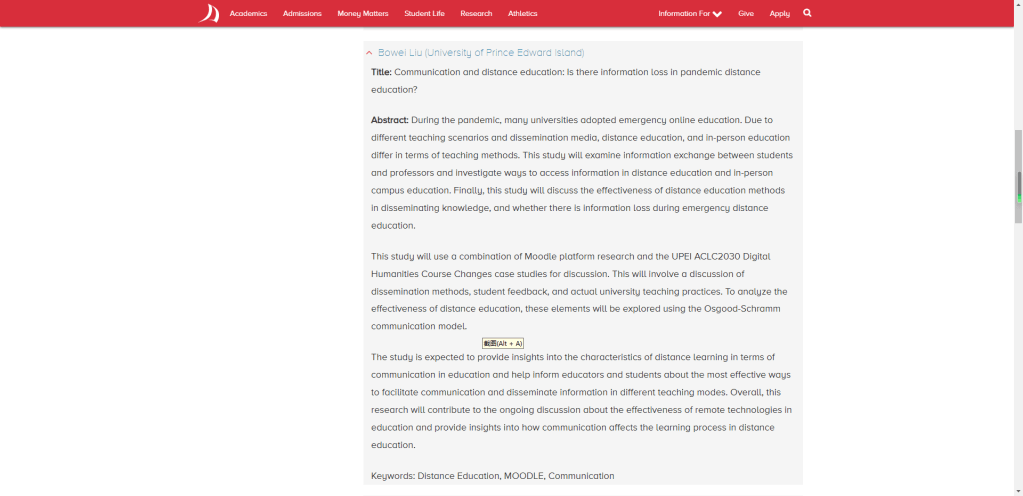
Communication and distance education: Is there information loss in the pandemic
1914Words
Abstract
During the pandemic, many universities adopted emergency online education. Due to different teaching scenarios and dissemination media, distance education, and in-person education differ in terms of teaching methods. This study will examine information exchange between students and professors and investigate ways to access information in distance education and in-person campus education. Finally, this study will discuss the effectiveness of distance education methods in disseminating knowledge, and whether there is information loss during emergency distance education. This study will use a combination of Moodle platform research and the UPEI ACLC2030 Digital Humanities Course Changes case studies for discussion. This will involve a discussion of dissemination methods, student feedback, and actual university teaching practices. To analyze the effectiveness of distance education, these elements will be explored using the Osgood-Schramm communication model. The study is expected to provide insights into the characteristics of distance learning in terms of communication in education and help inform educators and students about the most effective ways to facilitate communication and disseminate information in different teaching modes. Overall, this research will contribute to the ongoing discussion about the effectiveness of remote technologies in education and provide insights into how communication affects the learning process in distance education.
Keywords: Distance Education, MOODLE, Communication
Distance Education under Covid-19
Distance education, also known as Online Learning, is a form of education that takes place outside of traditional classrooms, usually through technology-mediated interactions. Distance education has been around for decades, with the earliest forms being correspondence courses that used the mail to send instructional materials to students. (Stracke C,2022) With the advent of the internet and digital technologies, distance education has evolved to include online learning, virtual classrooms, and other forms of remote education. In recent years, distance education has gained popularity due to its flexibility, convenience, and accessibility. It has enabled learners from diverse backgrounds and locations to access education, regardless of their physical location or time constraints. Distance education has also provided opportunities for adult learners, working professionals, and individuals with disabilities to pursue education at their own pace.
However, the COVID-19 pandemic has accelerated the adoption of distance education worldwide. “Education systems in all countries witnessed severe disruptions and radical changes during varying degrees of lockdown.”(Stracke. C,2022)In response to the pandemic, educational institutions worldwide were forced to transition from traditional in-person teaching to remote learning methods, such as online classes and virtual classrooms. This transition has highlighted the importance of digital technologies in enabling distance education and providing continuity of education during times of crisis.
It is important to note that distance education in the traditional sense is different from emergency remote teaching during an epidemic. According to Mavroudi and Papanikolaou, the description of distance education(DE) and emergency remote teaching(ERT). DE means Online courses already offered before COVID-19. this type, of course, has a well-defined course purpose and course design.ERT means In-person courses that were urgently modified to online courses during COVID-19. The loss of information discussed in this paper and the comparison with In-person courses comes from such courses.
In summary, distance education has been a part of the educational landscape for decades, but the COVID-19 pandemic has accelerated its adoption and highlighted the importance of digital technologies in enabling remote learning. As we move forward, it is essential to address the challenges and limitations of distance education and continue to innovate and improve our approaches to providing quality education for all
Research Methodology
Using the UPEI course ACLC-2090 Digital Humanities as a case study, we will analyze the interaction patterns, student feedback, and teaching practices as the actual results using the Osgood-Schramm communication model to find the semantic noise and semantic barriers. UPEI-2090 is a very typical case study in that this course is a reading-intensive course with some hands-on learning of software, making the teaching situation very complex. (MacFadyen, J, 2023) Before Covid-19, this course was an In-person course, after Covid-19 the course was forced to change to an online course and went through a gradual conversion to a hybrid course after the epidemic improved.
We will put ACLC-2090 into the Osgood-Schramm Model of Communication for analysis. This model is a model of communication process analysis, whose main feature is the ability to treat each individual as an equal communicator. (Drew, C,2019) According to Dr, Chris, the Osgood-Schramm Model Of Communication emphasizes four principles. “That communication is circular, not linear. The listener can both receive and send messages (in most instances). That communication is usually equal and reciprocal. There is much interpretation involved when receiving a message. All communication requires three steps: encoding, decoding, and interpreting a message.”
A 2022 study by the University of Oslo, it was found that traditional and online education “no significant differences between the two groups in scores regarding course structure flexibility and the degree of student autonomy; however, significant difference with a high effect size was found regarding instructional dialogue” (Mavroudi, A., & Papanikolaou, K.) The Osgood-Schramm Model Of Communication Model has been criticized as being unsuitable for studies of mass communication, but rather for studies of interpersonal communication where feedback is more frequent. The small classroom interactive communication model of distance education is well suited to bring in this model for sub-licensing.
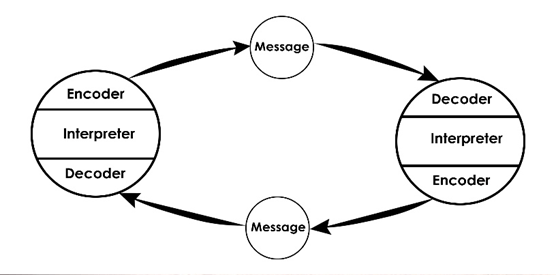
Table1. Drew, C. (September 5, 2019). Osgood-Schramm Model of Communication – Pros & Cons. Helpful Professor. https://helpfulprofessor.com/osgood-schramm/)
Case Study Results and Discussion
The Digital Divide
After putting the case into the model for analysis, the first problem we found was in the translation part. Here a digital divide emerged as the course proceeded. The digital divide is a gap in the use of digital devices due to the uneven development of digital technology in the world. (Stracke, C, 2022) According to a UN Health survey, only 2% of students in France experience problems with the digital divide, and most of these problems are periodic network fluctuations. In Turkey, on the other hand, the digital divide is a serious problem, and the government has had to invest a lot of financial resources to address the problem of students linking to the Internet during Covid-19.
In ACLC-2090, the digital divide is not as pronounced, but it still has an impact on students. the software needed for ACLC, ArcGIS, is paid software, and companies need to pay ArcGIS a yearly royalty to use the software. (MacFadyen, J, 2023) The individual as a student is not able to use this software for personal use. Therefore students can only work on course projects by remotely controlling the school’s server, and some students’ computers do not support remote control, which leads to a break in the interpretation part of the model.
This creates difficulties for students’ learning. And after switching to blended learning mode, Professor Macfadyen replaced ArcGIS with QGIS for the lecture. The reason is that QGIS is free software that students can easily download, thus avoiding the digital divide to some extent.
Creating a virtual environment
At the beginning of the curriculum, ACLC-2090 was designed as a hallway conversation. The original intention of this design was for students to create a virtual environment that simulates a discussion session after class. (MacFadyen, J, 2023) This channel can be said to be effective in enhancing the decoding and encoding sessions under the students as subjects in the communication model. “The students tried to make up for the physical presence by trying to interact constantly on the e-learning platform forum.” (Capone,2022)
Emergency remote teaching is a unique environment in which students often cannot see their classmates and professors, which exacerbates the tension they face and also somewhat diminishes their motivation to learn. “As can be seen from the qualitative data, participation, engagement, and motivation are altered by the emergency and the distance learning used.”(Capone, 2022) “In the context of the emergency of COVID-19, students have experienced moments of strong emotional stress, with the risk of generating a state of frustration and discouraging them from studying.”(Stracke, C,2022) So creating a comfortable virtual environment is necessary, and different factors can affect students’ motivation to learn to some extent. “The use of an adaptive e-learning platform and the restructuring of educational content through the use of technologies, which led students to have a high level of engagement for the duration of the course, seem to have contributed to containing the phenomenon of drop-out feared at the beginning of the course through distance learning methods.” (Stracke, C)
For this reason, creating hallway conversations was a necessary part of the process. The same is true for the data analysis of hallway conversations, which generated 11 Posts 19 Replies during the online course, 7 Posts 10 Replies during the hybrid course, and finally during the In-person course, the hallway conversations were canceled. The reason for this was that no one was using the board.
Teaching practice, distance learning teaching model
The last issue identified was in the structure of the live courses, where the authoritative delivery model of traditional In-person courses did not lend itself to distance learning. This made it appear that the professor was unable to disseminate the coding part of the dissemination without clarity. The most frequently-adopted interaction methods are “Teacher proposes question and student answers it” and “Group discussion”, followed by “Student proposes question and teacher answers it”( Meiji,2022)An important part of the decoding model here is the teacher-student interaction model during the class.
Diversified educational methods in Emergency remote teaching, here ACLC-2090 used Question and Quiz, Group work, Creating The creation of virtual environments has been mentioned above. The questions are designed to enable the professor to effectively perceive the students’ progress and assess the effectiveness of learning. The group discussions are designed to allow students to establish links and interact with each other for course information, and to alleviate anxiety to some extent.
Conclusion
In conclusion, “The state of mind of the students influenced the study.”(Capone,2022) To ensure that all students have an equal opportunity to succeed, it is important to address the digital divide and provide them with the necessary resources and support. Additionally, establishing effective feedback channels can help students feel more engaged and supported in their learning, which can further enhance their success. By recognizing and addressing these factors, we can help create a more equitable and effective learning environment for all students, regardless of their location or background.
This study uses a communication science perspective to analyze educational cases in the hope of bringing new perspectives to the evaluation of course design effectiveness in distance education.
The use of communication science as a framework for analyzing educational cases in distance education can provide valuable insights into the effectiveness of course design. Communication science is a multidisciplinary field that seeks to understand how people communicate, how messages are received and interpreted, and how communication can be optimized to achieve specific goals. By applying this perspective to the analysis of distance education, researchers can gain a better understanding of how various factors, such as technology, teaching methods, and student engagement, can affect the learning process.
Using communication science in the evaluation of course design effectiveness in distance education is that it allows for a more nuanced understanding of the various factors that contribute to student success. By addressing these barriers and noise, educators can create a more supportive and engaging learning environment for their students, which can lead to better learning outcomes.
Reference
Capone, R., & Lepore, M. (2022). From distance learning to integrated digital learning: A fuzzy cognitive analysis focused on engagement, motivation, and participation during the COVID-19 pandemic. Technology, Knowledge, and Learning: Learning Mathematics, Science and the Arts in the Context of Digital Technologies, 27(4), 1259-1259–1289. APA PsycInfo. https://doi.org/10.1007/s10758-021-09571-w
Grytsiuk, O., Herasymenko, L., Nabok, T., Bryl, T., & Maksimova, L. (2022). Assessment of Learning Outcomes in Distance Learning Using the Moodle Platform (edseee.10005777). 1-1–4. IEEE Xplore Digital Library. https://doi.org/10.1109/MEES58014.2022.10005777
Hristova, G., & Netov, N. (2022). Media Coverage and Public Perception of Distance Learning During the COVID-19 Pandemic: A Topic Modeling Approach Based on BERTopic (edseee.10020466). 2259-2259–2264. IEEE Xplore Digital Library. https://doi.org/10.1109/BigData55660.2022.10020466
KREYDUN, N., NALYVAIKO, O., IVANENKO, L., ZOTOVA, L., NEVOIENNA, O., IAVOROVSKA, L., KHARCHENKO, A., & SEVOSTIANOV, P. (2022). The Quality of Education in the Conditions of Forced Distance Learning Caused by COVID-19. Romanian Journal for Multidimensional Education / Revista Romaneasca Pentru Educatie Multidimensionala, 14(4), 423-423–448. Academic Search Complete. https://doi.org/10.18662/rrem/14.4/649
MacFadyen, J., Hoy, B., & Clifford, J. (n.d.). The Geospatial Humanities. Retrieved March 14, 2023, from https://pressbooks.library.upei.ca/geospatialhumanities/
Mavroudi, A., & Papanikolaou, K. (2022). A Case Study on How Distance Education May Inform Post-Pandemic University Teaching. International Review of Research in Open & Distance Learning, 23(4), 57-57–74. Education Research Complete. https://doi.org/10.19173/irrodl.v23i4.6245
Meiji Pan. (2022). Students’ Willingness to Participate in Interactive Teaching in the Context of Distance Education. International Journal of Emerging Technologies in Learning, 17(18), 38-38–52. Education Research Complete. https://doi.org/10.3991/ijet.v17i18.34179
Stracke, C. M., Sharma, R. C., Bozkurt, A., Burgos, D., Cassafieres, C. S., dos Santos, A. I., Mason, J., Ossiannilsson, E., Santos-Hermosa, G., Shon, J. G., Wan, M., Agbu, J.-F. O., Farrow, R., Karakaya, Ö., Nerantzi, C., Ramírez-Montoya, M. S., Conole, G., Cox, G., & Truong, V. (2022). Impact of COVID-19 on Formal Education: An International Review of Practices and Potentials of Open Education at a Distance. International Review of Research in Open & Distance Learning, 23(4), 1-1–18. Education Research Complete. https://doi.org/10.19173/irrodl.v23i4.6120
 Bowei's Personal Blog