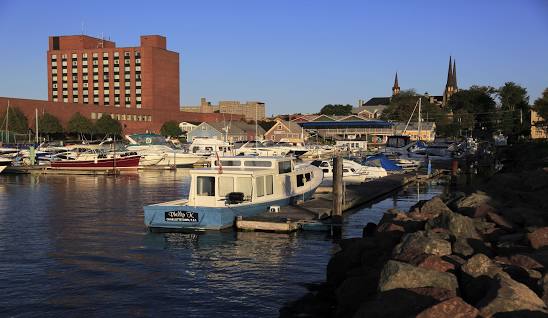
From lighthouse to Boston boat
The Rise and Decline of Charlottetown Harbor
From lighthouse to Boston boat
Charlottetown Harbor History Research
When I first saw the Charlottetown Harbor, most of the area had been transformed into parks and memorial museums, only a few of the port area. There is only one berth for large ships. After the decline of local shipbuilding and shipping industry in the 19th century, most of the port areas were demolished and built into parks or other tourist facilities. In modern times, it has gradually been built into the form of Charlottetown Harbor that we see now.
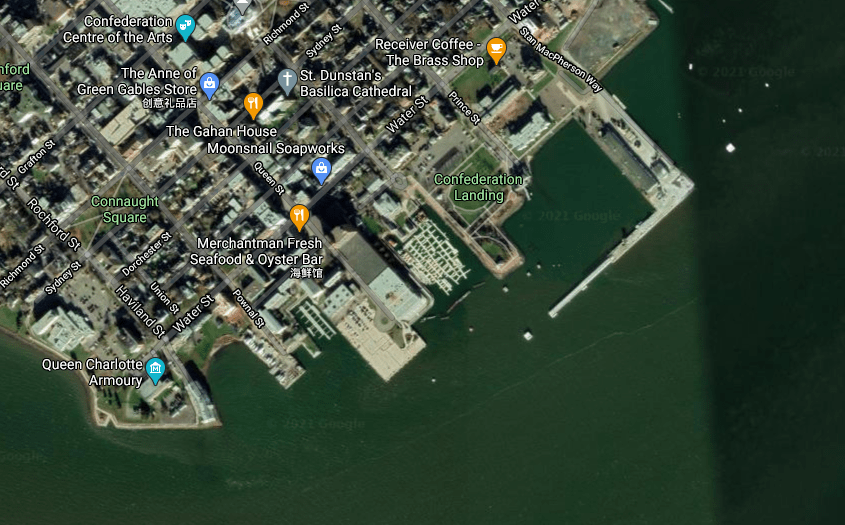
https://www.google.ca/maps/@46.2318935,-63.1230737,806m/data=!3m1!1e3?shorturl=1
But when we look at photos of Charlottetown harbor in the 19th century. We will find a lot of port berths. Many ships are here. Ships from all over the world have created a prosperous shipping industry in Charlottetown Harbor. The prosperity of Charlottetown Harbor continued throughout the 19th century and began to decline at the end of the 19th century.

National Archives of Canada-Aerial 1925 (1)
When the first European settlers in Charlottetown.[1] Charlottetown Harbor was built for passenger and freight transport.[2] As one of the best natural ports in the world, it was soon built into a port area, which is known as Charlottetown Harbor. Then lighthouses and large shipyards were built here. Charlottetown Harbor was gradually established as a large port. For hundreds of years, Charlottetown Harbor continued to expand. On the 19th century Charlottetown Harbor became one of the most important ports in PEI. With the increase in the number of ships sailing in Charlottetown Harbor, people pay more attention to the construction of Charlottetown Harbor(Construction of infrastructures such as lighthouses), And new routes (to Montreal and Boston). We will talk about the rise of Charlottetown Harbor along with the track of 19th history.
In order to intuitively feel the changes of port prosperity. We used the Charlottetown Harbor arrival register database.[3]By collecting the data of 2390 ships entering and leaving the port, we get a data visualization table about the busy degree of the Charlottetown Harbor. We will be divided those data into three stages. In the early 19th century, in the middle of the 19th century, and in the late 19th century. We will talk about the development of Charlottetown Harbor from different historical stages.
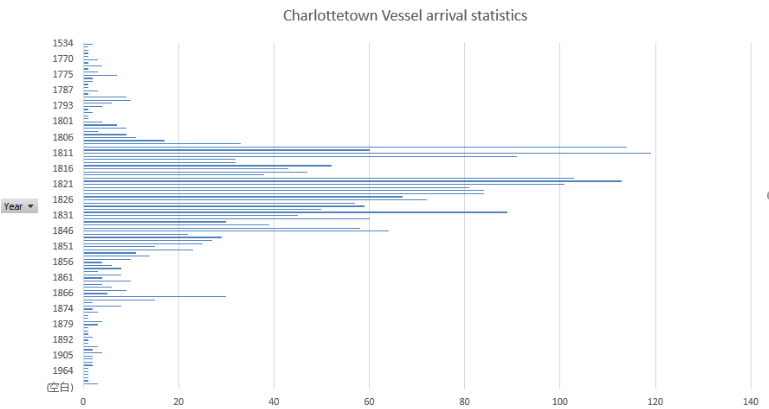
Charlottetown Vessel arrival statistics
The data we grabbed came from:http://www.islandregister.com/ship_data.html
In the early 19th century. The establishment of Charlottetown Harbor.
When Samuel Holland chose Charlottetown as the capital of the colony (now the province of Prince Edward Island ) in 1765, it was due to its location at the base of three rivers and the fact that it had a good harbor. Up until the 1840s, there were two wharves on the waterfront but after that, the number of wharves grew to accommodate the increasing ship traffic due to the increasing size of the colony. Every day ships from all over the world enter the waters of Charlottetown. Transport supplies, people, livestock, mail and other things. In the early days of Charlottetown, there were no lighthouses or spotlights.[4] The colonies used a variety of navigation equipment, buoys and landmarks. For example, the spire of a church. Despite these facilities, it is still a difficult problem for ships to enter the port.
In the early 19th century, facilities were set up to serve ships. But these facilities are too simple. With the prosperity of port trade, more ships enter Charlottetown Harbor. At this time, people need more perfect port infrastructure construction.
In the middle of the 19th century. The golden age of Charlottetown Harbor.
Before airplanes and trains were invented, goods came here via the water so it was busier on the waterfront. In the mid-19th century up until the mid-20th century, there were numerous working wharves along the harbor. Some businessmen owned wharves and conducted business from them. In other cases, the public wharves like the Queen’s wharf and Pownal Wharf were used. Due to the rapid growth of ship traffic, lighthouses and spotlights have been built in the dock area to guide ships on the route. “The first lighthouse on the Island, Point Prim, was built in 1845 in response to Charlottetown merchants and ship owners requesting a light to guide ships into the Charlottetown Harbor. As ship traffic increased, a second lighthouse was constructed to help sailors bound for Charlottetown. The Blockhouse Point Lighthouse is located on the west side of the entry to the Charlottetown Harbor.”[5] The completion of these infrastructures will further increase the throughput of Charlottetown Harbor. It reached the peak of the 19th century.
Today, a lot of these wharves have changed into marinas, public areas and parks, however the area visible in the foreground of “The Rail Yard” image and what is referred to as the Railway Wharf is still used for docking cruise ships and receiving goods.
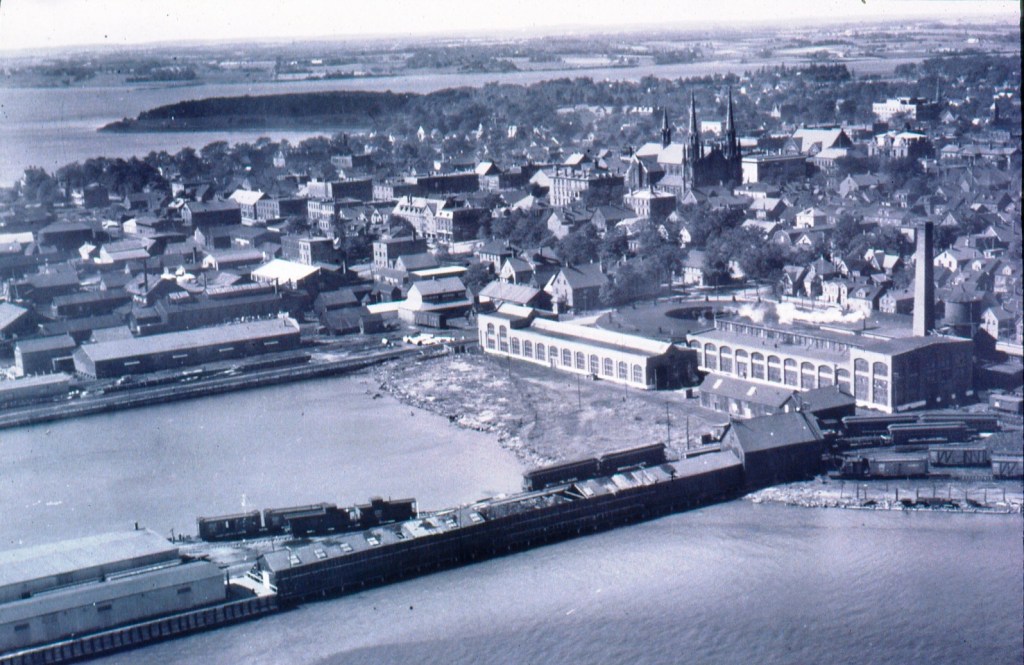
The Railway Wharf
In the late 19th century. The Charlottetown Harbor was finally perfected
During this period, the infrastructure construction of the port has tended to be perfect. More advanced range lights were built to guide ships. Two pairs of range lights were established in 1889 to guide vessels into Charlottetown Harbor along a channel clear of all obstructions. The Brighton Range Lights and the Haszard point Range Lights.[6] The addition of range lights has further improved the acceptance environment of the port. It was at this time that Boston boat began to appear in the port of Charlottetown.
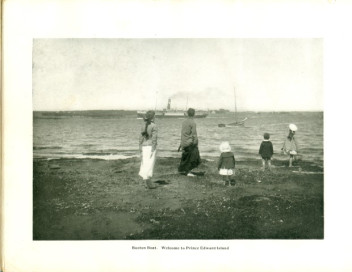
“This image depicts the SS Halifax at the mouth of the Charlottetown Harbor. The boat was part of a freight and passenger service and later, cruise line route that traveled back and forth from Prince Edward Island to Boston. It was also one of the earliest cruise ships to enter Charlottetown Harbor. In the winter, the SS Halifax would travel down south to the Caribbean where it was utilized as a cruise ship.”[7] This means that Charlottetown harbor has become an important part of intercontinental travel routes. This is due to the artificial infrastructure construction of Charlottetown harbor.
But for another group, things may not be so lucky. Prince Edward Island Steam Navigation Company[8]is a typical example They stopped ship service in 1883. In addition to the government’s ban, the aging of its own hull is another major factor. These ships came from the golden age of Charlottetown harbor in the mid-19th century. But now it’s overburdened. After that, there was no large number of ships registered in Charlottetown harbor at the end of the 19th century. The number of ships entering the port tends to be stable. The era of big growth is over.
Summary and Prospect
The development of Charlottetown Harbor almost kept pace with the colonial activities in North America. A large number of European immigrants came here by boat to build their new homes. With the development of the times. Due to the planning of railway and highway in Prince Edward Island, the status of maritime transportation gradually declined. ‘For much of the first half of the twentieth century Prince Edward Island’s main link with the rest of Canada was through Montreal. Toronto was hardly on the horizon. Montreal had succeeded Boston as the metropolis for the Island. Transportation links through the Intercolonial Railway were supplemented by an increasing sea connection through the Gulf of St. Lawrence and several companies were involved in the transportation of passengers and freight.’[9] At this time, a large number of port facilities were demolished and gradually became the familiar Charlottetown harbor.
It’s worth mentioning that during World War II. Charlottetown harbor, as a military port, built a large number of military ships and made its own contribution to the anti-fascist war.
Notes
[1] Toolkit, Web Experience. “French Settlement in the 1700s,” May 26, 2015. https://www.princeedwardisland.ca/en/information/executive-council-office/french-settlement-1700s.
[2] Sailstrait. “‘One of the Finest Harbours in the World’ – Charlottetown in 1860.” Sailstrait (blog), February 19, 2018. https://sailstrait.wordpress.com/2018/02/19/one-of-the-finest-harbours-in-the-world-charlottetown-in-1860/.
[3] “The PEI Ships Arrival/Departures Database – Index.” Accessed April 9, 2021. http://www.islandregister.com/ship_data.html.
[4] Charlottetown Stories. “Early Navigational Aids,” March 8, 2013. https://charlottetownstories.wordpress.com/exhibits/travel-and-transportation/navigation-of-the-charlottetown-harbour/early-navigational-aids/.
[5] Charlottetown Stories. “Lighthouses,” March 11, 2013. https://charlottetownstories.wordpress.com/exhibits/travel-and-transportation/navigation-of-the-charlottetown-harbour/lighthouses-and-range-lights/.
[6] Charlottetown Stories. “Range Lights,” March 13, 2013. https://charlottetownstories.wordpress.com/exhibits/travel-and-transportation/navigation-of-the-charlottetown-harbour/range-lights/.
[7] Charlottetown Stories. “Boston Boat. Welcome to Prince Edward Island,” November 18, 2019. https://charlottetownstories.wordpress.com/picturing-a-city-exhibits/picturing-a-city-early-20th-century-charlottetown/boston-boat-welcome-to-prince-edward-island/.
[8] sailstrait. “The Day the Steamers Stopped: Mainland Cut-off Again!” Sailstrait (blog), December 15, 2020. https://sailstrait.wordpress.com/2020/12/15/the-day-the-steamers-stopped-mainland-cut-off-again/.
[9] Sailstrait. “‘One of the Finest Harbours in the World’ – Charlottetown in 1860.” Sailstrait (blog), February 19, 2018. https://sailstrait.wordpress.com/2018/02/19/one-of-the-finest-harbours-in-the-world-charlottetown-in-1860/.
Photo
[1]Boston Boat. Welcome to Prince Edward Island
Frank M Stewart Collection, City of Charlottetown Archives :data:image/jpeg
[2] https://www.google.ca/maps/@46.2318935,-63.1230737,806m/data=!3m1!1e3?shorturl=1
获取直接发送到收件箱的新内容。
 Bowei's Personal Blog